
Every year, millions of people walk barefoot across the dust of Rajasthan, saffron flags on their shoulders, chanting two syllables: Shyam, Shyam. They are not heading to a grand royal monument or a celebrated wonder. They are walking toward a small marble temple in a quiet town called Khatu, in Sikar district, to bow before a deity who is worshipped not as a whole body, but as a severed head.That single fact tells you this is no ordinary story.
To understand Khatu Shyam Ji, you have to travel back to the Mahabharata, to a warrior so powerful he could have ended the greatest war in Hindu mythology in a single minute, and to a sacrifice so complete that Lord Krishna gave the young man his own name. This is the full history of Khatu Shyam Ji -the legend, the temple, and the reason a fallen warrior became one of India’s most beloved gods.
Table of Contents
ToggleWho is Khatu Shyam Ji?
Khatu Shyam ji also known as Sheesh Ke Daani which means the donor of his head. He is worshipped as the epitome of selflessness and devotion. However, shri khatu shyam ji mandir attracts devotees from around the world. further, his devotees believes that he listens to their prayer, fulfil their wishes and provides solace to fight challenging times. Not only this, but he is also known as the Deity of Kaliyuga. He is seen as a god who understand human struggles and offers unconditional love and guidance. Apart from that, his story teaches us profound lessons in sacrifice, humility and importance of serving humanity.
Who Was Barbarik, the Warrior Behind Khatu Shyam?
Long before he became a god, he was a boy with extraordinary lineage.
Barbarik was born to Ghatotkacha -the half-demon son of the Pandava prince Bhima -and Maurvi (also called Ahilawati), a Naga princess and a skilled warrior in her own right. That makes Barbarik the great-grandson of the Pandavas through Bhima’s line. Warfare ran in his blood, and his mother personally trained him in it.But bloodline alone didn’t make him invincible. His devotion did.
Barbarik was a fierce devotee of Lord Shiva. Through intense penance he earned a boon that would define his entire legend: three infallible arrows (the Teen Baan), which is why he is still called Teen Baan Dhari -the bearer of three arrows. Tradition also holds that Agni, the god of fire, gifted him a bow that made him unconquerable across the three worlds.
These were no ordinary weapons. Here is how the three arrows worked:
- The first arrow marked everything Barbarik wished to destroy.
- The second arrow marked everything he wished to protect.
- The third arrow then destroyed everything the first had marked, before returning to his quiver.
In practical terms, this meant Barbarik could win any battle in moments. When Krishna later asked the assembled warriors how long each would take to finish the Kurukshetra war single-handedly, the legends record answers in days -Bhishma, Drona, Karna, Arjuna all measuring their power in weeks. Barbarik’s answer? One minute.
Read Also – Top 7 Must-Visit Heritage Sites in Rajasthan
The Vow That Worried Even Krishna
Here is where the story turns from a tale of strength into a moral dilemma worthy of the Mahabharata.
When war between the Pandavas and Kauravas became inevitable, Barbarik wanted to witness it. He made a promise to his mother before leaving: he would always fight on the side that was losing. To a young warrior, this sounded like pure justice -never crush the weak, always lift the loser.But Krishna saw the catastrophe hidden inside that noble vow.
Think it through, as Krishna did. If Barbarik joins the losing side, that side starts winning -which makes the other side the loser. So he switches. Now the other side wins, and he must switch again. He would oscillate endlessly between the two armies, destroying both until nothing remained. The “champion of the weak” would end up the lone survivor of a war that wiped out everyone else. There would be no victory, no dharma restored, no future. Just one man standing on a field of total annihilation.Krishna could not allow that. So he devised a test.
The Peepal Tree Test: How Krishna Measured Barbarik's Power
Ambiguous as a humble Brahmin, Krishna approached the young warrior and gently mocked him -how could anyone go to the greatest war in history armed with just three arrows?
To prove their power, Krishna challenged Barbarik to pierce every single leaf of the peepal (sacred fig) tree they stood beneath, using a single arrow. Barbarik accepted, closed his eyes, and entered meditation before releasing.
In that moment, Krishna quietly plucked one leaf and hid it under his foot.The arrow flew, marked every leaf on the tree -and then began hovering insistently around Krishna’s foot. Barbarik calmly explained: there must be a leaf concealed beneath the Brahmin’s foot, and Krishna should lift it, or the arrow would pierce his flesh to reach its target.
Krishna lifted his foot. The hidden leaf was marked too.
This was the proof Krishna needed. The arrows were so absolute that even deliberately hidden targets could not escape them. If Krishna tried to hide the five Pandavas to keep them safe, Barbarik’s arrows would still find and destroy them. No strategy could outwit such a weapon.
The danger was now crystal clear.
Why Did Khatu Shyam Give His Head to Krishna?
Having confirmed Barbarik’s terrifying power, Krishna asked the young man which side he intended to support. Barbarik repeated his vow: the losing side. Krishna explained the paradox -that this very promise would lead to the destruction of both armies and leave Barbarik alone.
Then Krishna, still in his Brahmin form, asked for a charitable offering (daan). Barbarik, true to his word as a warrior who never refused a Brahmin, promised to give whatever was asked.Krishna asked for his head.
Barbarik was stunned -no ordinary Brahmin would demand such a thing. He requested to see the stranger’s true form, and Krishna revealed himself as the divine Lord. (By tradition, only Arjuna and Barbarik were granted the vision of Krishna’s cosmic form.) Now understanding that his sacrifice would protect dharma itself, Barbarik agreed without hesitation.
He made only one request: to witness the entire war he was giving his life to make possible.
Before offering his head, he is said to have made one of Hinduism’s most poignant sacrifices on the twelfth day of the bright half of the month of Phalguna -earning the name Sheesh ke Daani, the donor of the head. Krishna placed the severed-yet-living head atop a nearby hill, from where Barbarik watched every moment of the eighteen-day battle.
Why did Krishna cut Barbarik -or rather, why did he ask for the sacrifice? Not out of cruelty, but out of cosmic necessity. Barbarik’s power was so uncontrollable that his mere presence on the battlefield would have made the war meaningless and dharma impossible to restore. His removal was the only way the war could fulfil its purpose.
The Verdict From the Hilltop
When the war ended, the victorious Pandavas began to argue about who deserved the credit. Krishna offered a solution: ask the one impartial witness who had seen the whole war -Barbarik’s head.
Barbarik’s answer humbled them all. He said he saw no individual heroes winning the war. He saw only Krishna’s Sudarshan Chakra cutting down armies, and the Divine Mother in fierce form consuming the slain. The victory, he declared, belonged to Krishna alone. The Pandavas realised they had been instruments in a far larger divine plan.
Moved by Barbarik’s devotion, honesty, and sacrifice, Krishna granted the boon that created Khatu Shyam Ji: In the Kali Yuga, Barbarik would be worshipped by Krishna’s own name -Shyam -and whoever called upon him with a pure heart would have their troubles removed and their wishes fulfilled.A warrior who never fought a single battle became a god of hope for the defeated.
How Barbarik's Head Reached Khatu: The Temple's Origin Story
After the war, Barbarik’s sacred head was given to the rivers and eventually came to rest, buried, in the soil of a village in Rajasthan -the place we now call Khatu, in Sikar district. There it lay hidden through the turning of the ages, exactly as the boon had foretold: unseen until the Kali Yuga truly began.Then came the miracle that gives the temple its name.
A cow grazing near the spot began, every day, to spontaneously release her milk over one particular patch of earth -her udders pouring without any human touch. The astonished villagers dug at the site and uncovered the buried head. Around the same time, King Roop Singh Chauhan, the local ruler, is said to have received a divine instruction in a dream: install the head in a temple at that very place.And so the original temple was built. The site where the head emerged became the holy Shyam Kund, the sacred pond that still draws pilgrims today.
Exploring the Marble Beauty of Khatu Shyam Ji Temple
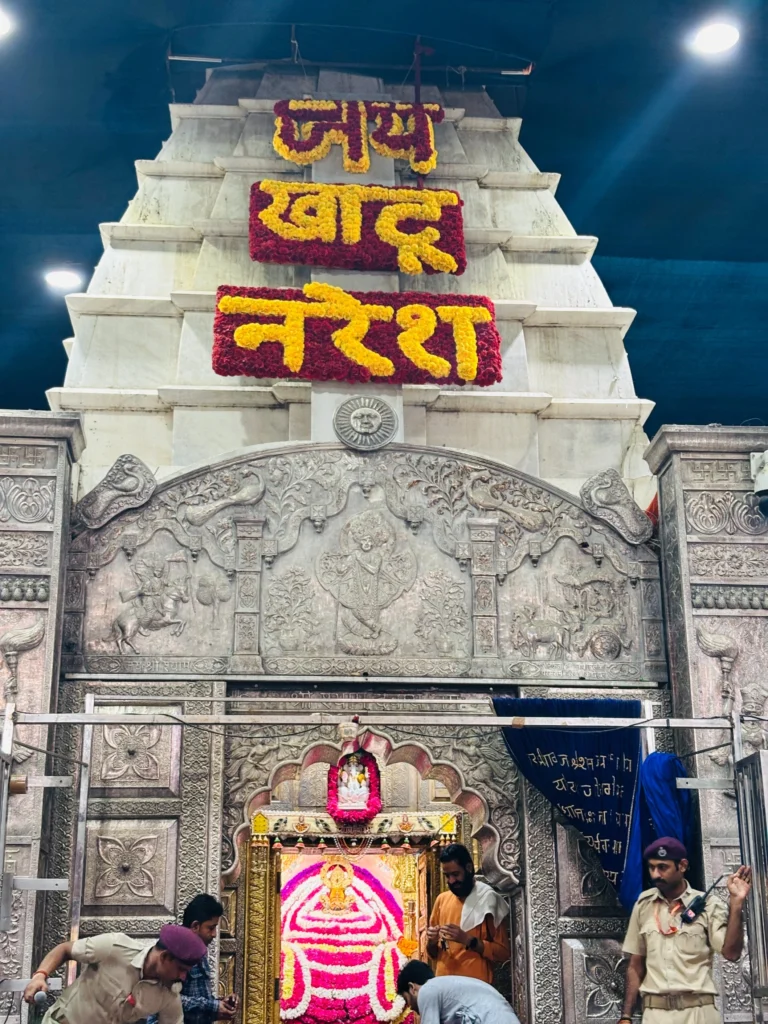
Khatu shyam mandir sikar rajasthan exhibits authentic Rajasthani architectural brilliance. However, the temple has white marble which makes it look ethereal glow especially when sunlight hit them. Temple has a intricate carvings on walls, pillars and ceilings which exhibits exceptional craftsmanship. However, when you enter the mandir you will see a grand archway which has got detailed artwork which entails all the mythological tales. Inside the mandir, you will see an idol of Khatu Shyam Baba. This idol is decorated with floral garlands, gold ornaments and silk cloth. Apart from that the temple has got serene design which is blended with aroma of incense and sound of devotional hymns. Altogether it creates a spiritual environment for you.
is barbarik and khatu shyam same
Khatu Shyam ji also has another name as Barbarika. He is revered divine figure having immense significance in the Hindu religion. As per Mahabharat, Barbarika was the grandson of Bhima who was one of the Pandavas. He is known for his unwavering commitment to dharma. Not only this, but he possessed celestial weapons and vowed which helps to support the weaker side in the Kurukshetra War. Prior to war, Barbarika was tested about his abilities by Lord Krishna. Once Krishna was impressed by his devotion, he asked Barbarika’s head as a sacrifice. Without even hesitation Barbarika gave the sacrifice which was placed on a hill to witness the war.
As the Lord Krishna was really impressed with Barbarika’s humility and devotion, he blessed him with a name “Shyam”. He proclaimed that Shyam would be worshipped in Kaliyuga as a deity of immense compassion and power. Not only this, but it is believed that the khatu shyam temple Sikar Rajasthan is built at the site where Barbarika’s head was buried. This makes it a deeply revered pilgrimage site for devotees.
The Phalgun Mela and Nishan Yatra: Faith in Motion
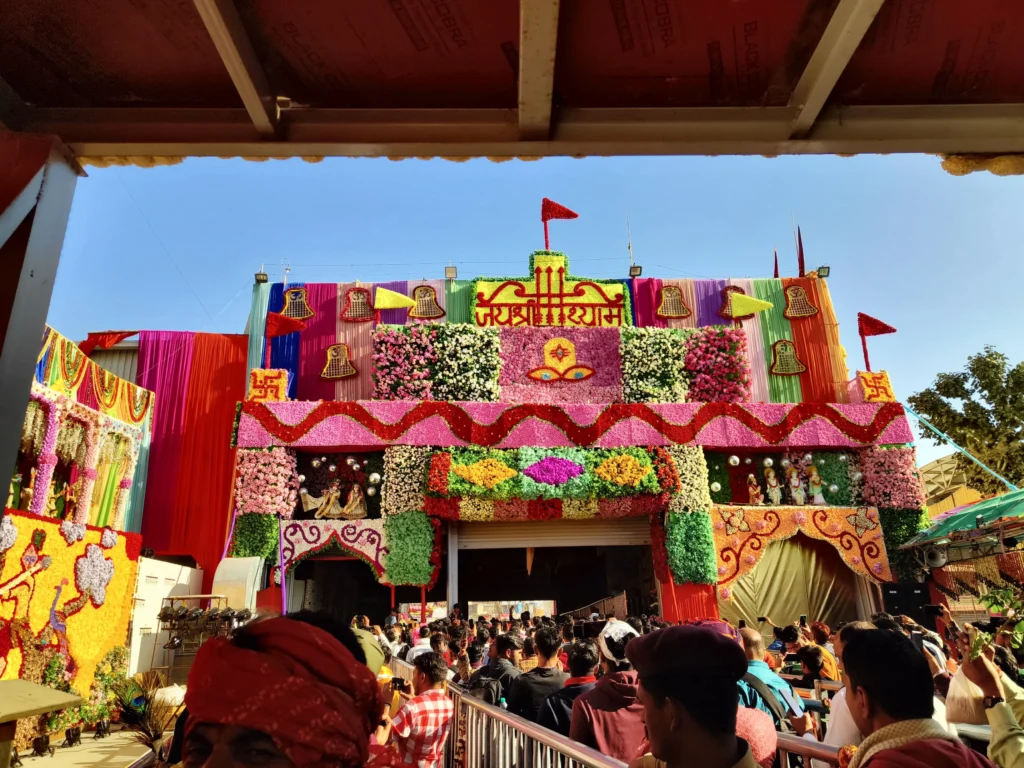
If you want to see Khatu Shyam’s power rather than read about it, visit during the Phalgun Mela (also called the Lakhi Mela), held in the Hindu month of Phalguna -usually February or March. The main fair runs from Phalgun Sudi Dashami to Dwadashi, marking the period associated with Barbarik’s sacrifice.
During the mela, the defining ritual is the Nishan Yatra. Devotees carry the nishan -a triangular saffron, orange, or red flag symbolising devotion -on foot, typically walking the roughly 17–18 km from Ringas to the Khatu temple, singing bhajans and chanting along the way. A centuries-old tradition also brings a special flag in a long foot procession from Surajgarh on the Rajasthan–Haryana border, raised atop the temple each year.It is a river of saffron, sometimes stretching for kilometres -one of the most striking displays of mass devotion in India.
Accommodation and facilities
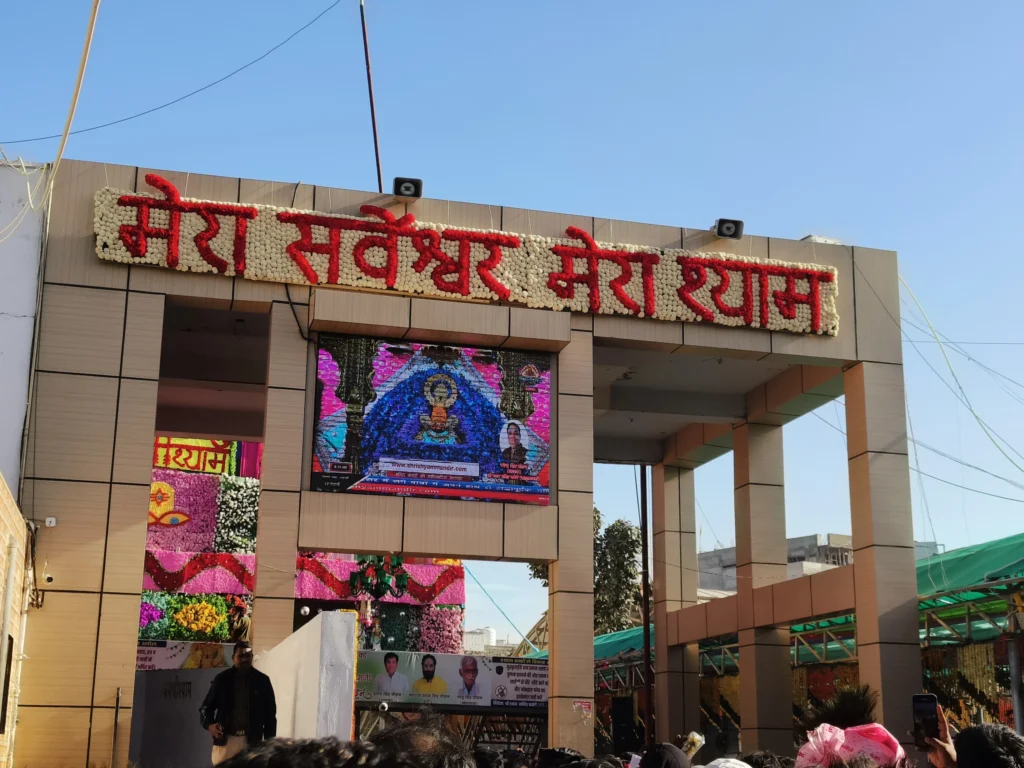
There are proper facilities to host the ever growing number of devotees. you can find different dharamshalas which are charitable lodging and hostel facilities. However, the facilities are managed by the temple trust and local communities which makes devotee’s experience a memorable moment.
Further, inside the temple, you can get clear drinking water, rest areas and well maintained queue for darshan. You can even explore the market and shop for devotional items, souvenirs and local delicacies.
Khatu shyam ji history is not just a temple but a spiritual journey, cultural landmark and a symbol of unwavering faith. Whether you are looking for an architectural beauty, vibrant festivals or divine blessings, you can come to Khatu Shyam ji. As this temple holds a special place in the heart of million devotees, not only this but it reminds us of the timeless values of devotion and selflessness. This makes it a must to visit destination for both faith and peace.
How to Reach Khatu Shyam Temple
For anyone planning a pilgrimage, the temple is well connected:
- By rail: The nearest station is Ringas Junction, about 17–18 km away, with onward taxis, jeeps, and buses to Khatu.
- By road: jaipur to khatu shyam distance 80 Km(about a two-hour drive) and well served by buses and taxis. From Delhi it’s approximately 270 km.
- By air: The nearest airport is Jaipur International Airport, around 80–95 km away.
The most pleasant time to visit is the cooler season, October to March, with the Phalgun Mela being the spiritual peak -and by far the most crowded.
Faqs
1. What is the history of Khatu Shyam Temple?
Khatu Shyam history in Rajasthan is dedicated to Barbarik, the grandson of Bhima from the Mahabharata. According to legend, Lord Krishna blessed him with the name Khatu Shyam after his sacrifice, making the temple a major spiritual destination for devotees.
2. Why is Khatu Shyam Ji famous?
Khatu Shyam Ji is famous for fulfilling devotees’ wishes and for his deep connection with the Mahabharata. Thousands of pilgrims visit the temple every year to seek blessings, peace, and spiritual strength from Shyam Baba.
3. What is the religious significance of Khatu Shyam Mandir?
Khatu Shyam Mandir holds great religious importance among Hindu devotees. People believe that worshipping Khatu Shyam Ji brings prosperity, removes difficulties, and fulfills sincere prayers. The temple is especially popular among devotees from Rajasthan, Haryana, and Gujarat.
4. Who is Khatu Shyam in Hindu mythology?
Khatu Shyam is believed to be Barbarik, the brave warrior and grandson of Bhima from the Mahabharata. Lord Krishna granted him a boon that he would be worshipped in Kaliyug as Shyam Baba for his sacrifice and devotion.
5. Where is Khatu Shyam Temple located?
Khatu Shyam Temple is located in Khatu village of Sikar district in Rajasthan, India. The temple attracts millions of devotees annually and is one of the most visited religious places in the state.
6. Why do Marwari people worship Khatu Shyam?
Many Marwari families worship Khatu Shyam Ji because they believe he protects families, blesses businesses, and fulfills wishes. Over time, devotion to Shyam Baba became deeply connected with Rajasthan’s local culture and traditions.
7. What are the beliefs associated with Khatu Shyam Temple?
Devotees believe that Khatu Shyam Ji listens to sincere prayers and helps people overcome life’s challenges. Many visitors also believe that offering prayers at the temple brings happiness, success, and spiritual peace.
8. What is the story behind Khatu Shyam Temple?
The story of Khatu Shyam Temple comes from the Mahabharata. Barbarik sacrificed his head before the war to Lord Krishna. Impressed by his devotion, Krishna blessed him to be worshipped as Khatu Shyam in the future.
9. What is Khatu Shyam Temple famous for?
Khatu Shyam Temple is famous for its spiritual atmosphere, beautiful architecture, and massive gatherings during the Falgun Mela festival. Devotees from across India visit the temple to seek blessings and fulfill religious vows.
10. What is the best time to visit Khatu Shyam Mandir?
The best time to visit Khatu Shyam Mandir is between October and March when the weather is pleasant. Many devotees also visit during the Falgun Mela festival, which is one of the temple’s biggest annual celebrations.